
My Favorite Spiritual Leadership Authors
We are all called to the right texts and the right authors at the right time. These three individuals played a big role in helping me to understand and practice spiritual development as leadership. Each book speaks to a different aspect of spiritual leadership: vibrational, evolutionary, and mystical. I highly recommend each of these books for anyone on their spiritual awakening journey.
Power vs. Force by David R. Hawkins
This book helped me to consciously understand and structure how we can have such radically different perceptions or experiences of the same event while all perceptions have a different layer of truth within them. It also clarified an inner knowing of sovereignty - sovereignty honors power and choice, not force. From a spiritual leadership perspective it helps to reinforce two key concepts:
1) Truth matters in creation and it has a vibrational scale, meaning many different shades…dimensions… of truth. Something can be more true or less true. The more truthful something is, the more power it holds within the unified field. False or low vibrations require and want coercion, want to force the self or others to change.
2) When we awaken this internally and consciously practice transforming vibrational truth, we as individuals increase our power not just in our lives but our power to create stronger vibrational truth in the larger collective reality. Falsehood and lower vibrations needs high volume of people for strength, to force others into their truth or reality; higher vibrational truth does not.

David R. Hawkins (1927–2012) was an American psychiatrist, spiritual teacher, and author. He earned an MD, worked in clinical psychiatry, and later became known for his writing and lectures on consciousness, spirituality, and human development. Hawkins developed a model of consciousness mapped on a logarithmic scale and presented it across several books. His work blends clinical experience, spiritual insight, and claims of calibrated levels of truth and consciousness.
Power vs. Force presents Hawkins’s central thesis that genuine power arises from higher levels of consciousness—truth, love, reason—while force stems from lower-energy states—fear, anger, pride—and is ultimately unsustainable. The book introduces a "map of consciousness," a calibrated scale that assigns numerical values to different emotional and spiritual states, claiming these calibrations can be determined through applied kinesiology (muscle testing). Hawkins argues that actions and ideas aligned with higher calibration levels have beneficial, long-term effects and attract truth, whereas forceful approaches produce resistance and negative outcomes.
The Leadership Revolution: Because Evolution Takes To Long
I am honored to have met Brian, and you can listen to interviews with him on my YouTube channel. Brian is a relatively unknown author, but his work and insights are of the same caliber as the known authors in my opinion. I appreciate greatly the framework he offers in this book as he really puts spirituality into practice and understands spiritual development for what it is: true leadership or love in action. Brian accurately perceived that leadership, like any other practice, has stages and requires mastery of various concepts to evolve to the next stage. He merges leadership with spiritual initiation so the inner world can meet the outer world in relationships, work, and everyday life situations. His practical, grounded insights and invitations will help you to ensure that you address each stage of your own spiritual leadership journey in your life, but also apply them to foster higher consciousness, more adaptable organizations.
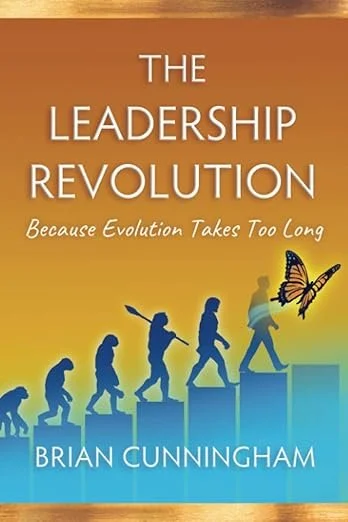
The Leadership Revolution argues that traditional, incremental approaches to leadership development are too slow for today’s complex, fast-changing organizations. Combining case studies, practical frameworks, and provocative insight, the book urges leaders to adopt a proactive, systemic approach that accelerates organizational change. Core themes include reframing leadership as a collective capability rather than an individual trait, redesigning structures and processes to enable rapid learning, and using decisive experiments to scale effective practices. The author outlines a step-by-step playbook for leaders: diagnose the system, set bold direction, build distributed decision-making, measure what matters, and iterate quickly. The tone balances urgency with pragmatic tools, offering leaders concrete actions—culture shifts, governance changes, talent practices—to create resilient, adaptive organizations that can outpace disruption.
Brian Cunningham is a leadership strategist, consultant, and speaker who helps organizations transform how they lead and learn. With experience advising senior executives across industries, the author combines academic grounding in organizational behavior with hands-on work implementing large-scale change programs. Known for pragmatic frameworks and a focus on measurable impact, they write and speak about distributed leadership, adaptive strategy, and accelerating capability building. Their work has been featured in industry publications and applied in companies ranging from startups to global enterprises.
Creative Meditation and Multi-Dimensional Consciousness
This book called me to the Arizona desert where it sat on a bookshelf at meditation retreat center. It was the only book I picked up, and from the first line on a random page, I understood that I came to this place to meet my teacher not in a room, but within this text. This book is profound, highly nuanced, and ready for anyone who is seeking a mentor on their journey into clarifying paradox and nourishing multi-dimensionality. It is not practical (though he gives exercises). It is not a narrative. It speaks directly to the unconscious with immense clarity of wisdom, poetry, and images. He is company and a mentor for you as you deepen and expand your own inner mystic. He writes from great gnosis for those who are experiencing their own gnosis. I include this in my spiritual leadership book list, because our mystic is how we awaken more of the unconscious and continue our expansion journey. If our mystic does not advance, our conscious leadership will be stunted.
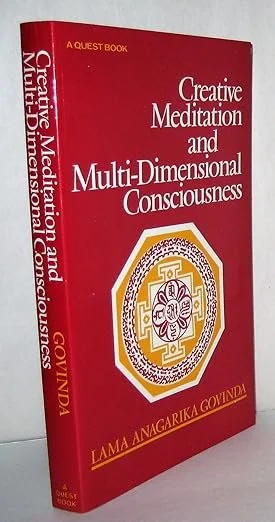
This compact, accessible work presents Govinda’s practical and theoretical approach to meditation as a creative, explorative process that opens awareness to multiple dimensions of consciousness. He outlines techniques for cultivating concentration, inner imagery, and symbolic visualization, and describes how disciplined practice can reveal layers of experience beyond ordinary waking awareness — including dream states, archetypal imagery, and transpersonal insights. The book emphasizes the interplay of imagination and disciplined attention, presenting meditation not merely as quieting the mind but as an active, transformative engagement that awakens creativity, expands perception, and fosters spiritual maturation. Practical instructions are paired with philosophical reflections on consciousness, making the text suitable for readers seeking both hands-on methods and a conceptual framework for multi-dimensional inner exploration.
Lama Anagarika Govinda — born Ernst Lothar Hoffmann (1898–1985) — was a German-born Buddhist writer, scholar, and practitioner who played a key role in introducing Tibetan Buddhist thought and practice to the West. After early studies in art and philosophy, he embraced Buddhist practice in the 1920s, living and teaching in India, Ceylon (Sri Lanka), and later Europe. Govinda combined deep scholastic knowledge of Buddhist doctrine with experiential insight from meditation; his work is noted for its clear exposition of esoteric practices, cross-cultural sensitivity, and efforts to integrate Eastern contemplative methods with Western intellectual inquiry.
